

Strategic Growth Models for Entrepreneurs: The Constraint-to-Model Framework

Mitch Wilder
Entrepreneur & Systems Thinker
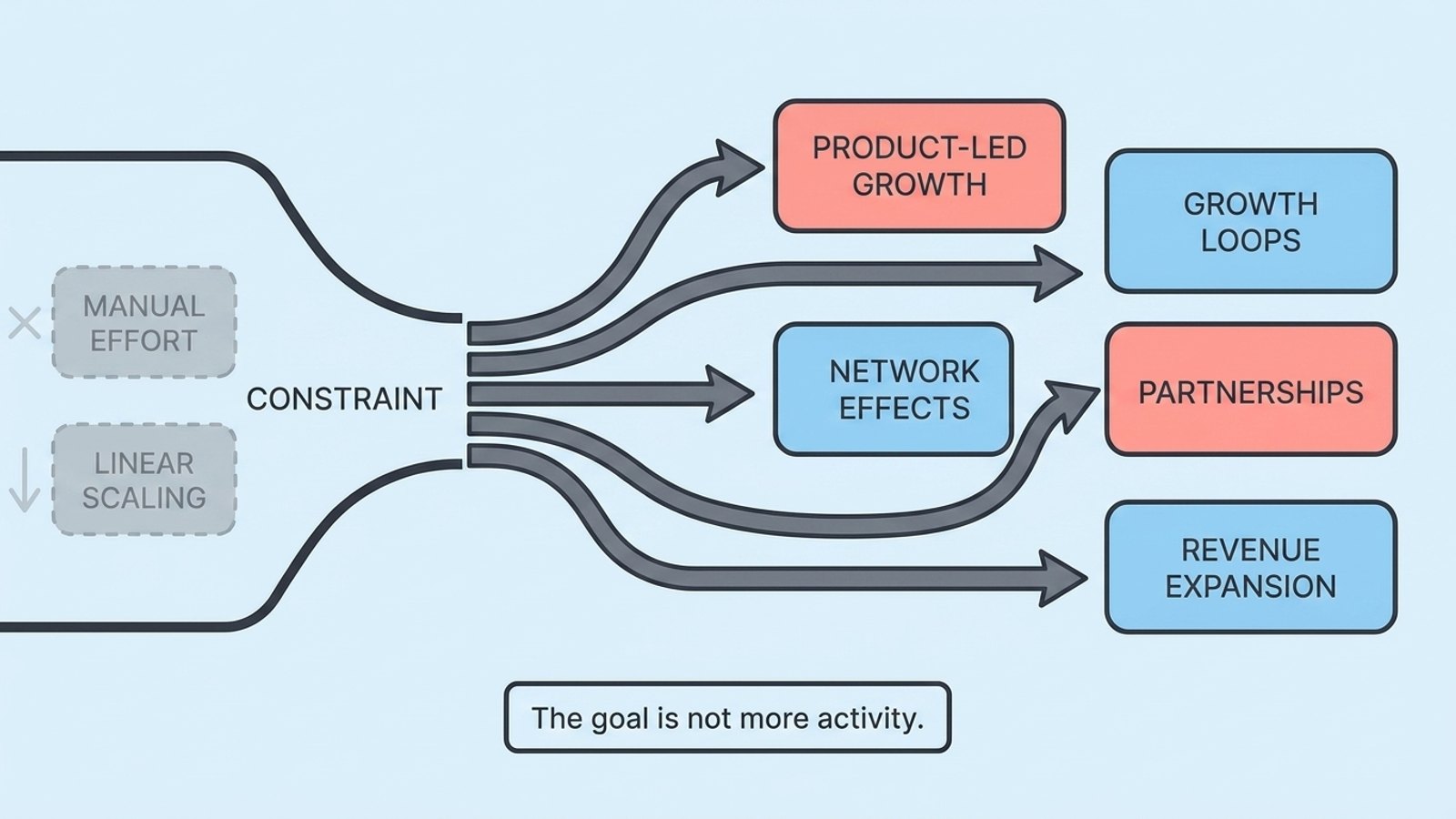
If every growth initiative feels like a high-stakes gamble, you probably do not have a tactics problem. You have a model problem.
I think this is one of the biggest mistakes entrepreneurs make. They run ads, publish content, launch features, test partnerships, and push harder on sales without first deciding how the business is supposed to grow. In this guide, I’m going to break down the most useful strategic growth models for entrepreneurs, show you when each one fits, and give you a simple framework for choosing the right one.
Quick answer
They are frameworks that explain how a business grows customers, revenue, market share, or defensibility in a repeatable way.
If every growth initiative feels like a high-stakes gamble, you probably do not have a tactics problem. You have a model problem.
I think this is one of the biggest mistakes entrepreneurs make. They run ads, publish content, launch features, test partnerships, and push harder on sales without first deciding how the business is supposed to grow. In this guide, I’m going to break down the most useful strategic growth models for entrepreneurs, show you when each one fits, and give you a simple framework for choosing the right one.
TL;DR
- Strategic growth models for entrepreneurs are frameworks that explain how a business grows revenue, customers, market share, or defensibility.
- A growth model is different from a strategy or a tactic. The model is the system. The strategy is the plan. The tactic is the move.
- The best growth model depends on your current constraint, not whatever model is trendy.
- The most practical way to choose is to identify the bottleneck, match it to a model, define the growth equation, pick one North Star Metric, and run focused experiments.
- Common high-value models include Lean Startup, product-led growth, growth loops, network effects, marketplace liquidity, partnerships, AI-driven growth, and revenue expansion.
- Marketplaces and networked products should think in terms of density, liquidity, and compounding interactions, not just traffic.
- SaaS companies often win through activation, retention, and expansion, not just top-of-funnel acquisition.
- The goal is not more activity. The goal is a repeatable growth system that compounds.
What are strategic growth models for entrepreneurs?
Strategic growth models for entrepreneurs are repeatable frameworks that explain how a business expands customers, revenue, market share, or network value over time. They matter because they help founders decide what to prioritize, what to measure, and where growth will actually come from.
My point is this: a tactic can create a spike. A growth model creates a system.
Growth model vs. growth strategy vs. growth tactic
This distinction clears up a lot of confusion.
| Concept | Meaning | Example |
|---|---|---|
| Growth model | The underlying engine of growth | Product-led growth, network effects, marketplace liquidity |
| Growth strategy | The plan for applying the model | Expand city by city to build marketplace density |
| Growth tactic | A specific action | Launch a referral campaign or run paid search ads |
If you skip the model and jump straight to tactics, you end up busy but not scalable.
How do you choose the right growth model?
You choose the right growth model by starting with your biggest growth constraint. In other words, do not ask, “Should we do partnerships?” Ask, “What is slowing growth right now?”
Look at these common constraints:
- Weak demand
- High customer acquisition cost
- Poor activation
- Low retention
- Slow sales cycles
- Low expansion revenue
- Supply-demand imbalance
- Limited operational capacity
- Weak defensibility
Then match the constraint to the model.
| If your business needs... | Consider this model |
|---|---|
| Faster validation | Lean Startup |
| Better self-serve acquisition | Product-led growth |
| Lower CAC over time | Growth loops or content-led growth |
| Stronger moat | Network effects or platform model |
| Better marketplace performance | Cold start or liquidity model |
| Higher LTV | Revenue expansion |
| More leverage with fewer people | AI-driven growth |
| New distribution channels | Partnerships |
| Clarity on expansion direction | Ansoff Matrix |
The Constraint-to-Model Framework
The way that I look at it, most growth advice is too abstract. Entrepreneurs need a decision system. That’s why I use a simple constraint-to-model framework.
1. Identify your growth constraint
Start with the bottleneck that is most limiting growth right now.
Examples:
- Traffic is fine, but users do not activate
- Customers buy once, but do not stay
- Demand exists, but supply is thin
- Sales cycles are too long
- Operations are becoming the bottleneck
2. Match the constraint to a growth model
Use direct selection rules:
- If retention is weak, focus on product-led onboarding or revenue expansion
- If CAC is too high, focus on content-led growth, partnerships, or growth loops
- If your marketplace is not transacting, focus on cold start and liquidity
- If the product gets more valuable with more users, focus on network effects
- If manual work is slowing scale, focus on AI-driven growth
3. Define the core growth equation
Every model needs math behind it.
Examples:
- SaaS revenue = Traffic × Signup Rate × Activation Rate × Paid Conversion × Retention × Expansion
- Marketplace GMV = Demand × Supply × Match Rate × Transaction Frequency × Average Order Value × Take Rate
- Networked product growth = New Users × Activation × Connections Created × Repeat Engagement × Invites Sent
4. Choose one North Star Metric
Pick one metric that best captures repeatable value creation.
Examples:
- Weekly active teams
- Successful matches
- Activated users
- Qualified pipeline
- Net revenue retention
- Transaction volume
5. Run experiments
Run 30- to 90-day growth sprints with a clear hypothesis, owner, budget, and success metric.
6. Codify the playbook
When something works, document it. A growth model becomes valuable when the team can repeat it.
7. Scale what compounds
Double down on the systems that become stronger with use. That is where leverage lives.
The most useful strategic growth models for entrepreneurs
Here are the strategic growth models for entrepreneurs that matter most in practice.
Lean Startup
Lean Startup is the right model when uncertainty is high and customer learning matters more than speed.
This model is built around build-measure-learn. It is best for early-stage startups, new products, and unproven markets.
Choose it when:
- You do not yet know what customers want
- You are testing new product categories
- Capital is limited
- You need signal before scale
Avoid the common mistake of treating an MVP like a bad product. The purpose is not to ship something sloppy. The purpose is to learn the fastest.
Product-led growth
Product-led growth works when the product can demonstrate value faster than a salesperson can explain it.
This is one of the strongest growth models for startups in SaaS, AI tools, collaboration software, and developer products.
Best indicators:
- Fast time to value
- Self-serve onboarding
- Team-based adoption
- Natural in-product sharing
- Expansion inside accounts
Track:
- Activation rate
- Free-to-paid conversion
- Product-qualified leads
- Net revenue retention
Growth loops
Growth loops are compounding systems where one user action creates more acquisition, engagement, data, or revenue.
A funnel is linear. A loop compounds.
There are a few common loop types:
- Viral loops: users invite users
- Content loops: content created by the company or users attracts more users
- Data loops: usage improves the product, which attracts more usage
- Marketplace loops: more supply attracts more demand, and vice versa
If you want durable scale, look for actions inside the product that naturally create the next wave of growth.
Network effects
Network effects happen when the product becomes more valuable as more people use it.
This matters because network effects create defensibility. They can lower future acquisition friction, improve retention, and make the business harder to copy.
There are several forms:
- Direct network effects: more users benefit other users directly
- Indirect network effects: one side of the market attracts another
- Data network effects: more usage improves intelligence and personalization
- Social network effects: identity, reputation, and relationships add value
Network effects are not a marketing trick. They are business architecture.
Marketplace liquidity
Marketplace liquidity is the model to focus on when your business only works if buyers and sellers reliably transact.
For marketplaces, traffic alone means very little. What matters is whether the right demand meets the right supply fast enough, often enough, and with enough trust to create repeat behavior.
Track metrics like:
- Match rate
- Fill rate
- Time to transaction
- Supplier utilization
- Repeat purchase rate
A lot of founders over-invest in demand before fixing supply quality. That usually backfires.
Revenue expansion
Revenue expansion is the model where growth comes from making current customers more valuable over time.
This is one of the most overlooked business scaling models. It works especially well in SaaS, subscriptions, agencies, and B2B services.
Expansion can come from:
- Upsells
- Cross-sells
- More seats
- More usage
- Premium features
- Outcome-based pricing
If customers are succeeding, expansion is often the cleanest path to efficient growth.
Partnership growth
Partnership growth uses outside distribution, trust, or product adjacency to accelerate growth.
This works well when your buyers already trust another platform, agency, consultant, or technology partner.
Strong partnership motions include:
- Channel partnerships
- Referral partnerships
- Integration partnerships
- Co-marketing
- Ecosystem alliances
Choose this when direct acquisition is expensive and there is a logical handoff from another trusted player.
AI-driven growth
AI-driven growth means using AI to improve a core bottleneck in acquisition, operations, personalization, support, or decision-making.
I think this is where a lot of businesses get distracted. AI is not the model just because AI is present. It becomes a real growth model when it improves a growth equation in a measurable way.
Good use cases include:
- Better lead scoring
- Smarter recommendations
- Faster support resolution
- Improved marketplace matching
- Automation of repetitive workflows
- Dynamic pricing and forecasting
If AI does not improve a specific constraint, it is just decoration.
A real lesson founders keep learning the hard way
I see this all the time. I have watched founders run paid ads, post on LinkedIn, start a blog, hire a freelancer, experiment with email, and still have no consistent pipeline. The problem was not effort. The problem was unfocused effort. Once they got clear on who they served, what outcome they promised, and where the funnel was breaking, the growth model got simpler and the tactics started working together.
That lesson matters here because a growth model should start with the customer and the bottleneck, not the channel.
Which growth model should you use at each stage?
The right growth model changes as the business matures.
Pre-product-market fit
Choose:
- Lean Startup
- Manual validation
- Early content-led learning
- Narrow marketplace testing
Focus on:
- Activation
- Retention
- Customer interviews
- Willingness to pay
Post-product-market fit
Choose:
- Product-led growth
- Growth loops
- Revenue expansion
- Content-led acquisition
Focus on:
- CAC payback
- Conversion
- Expansion revenue
- Referral rate
Scaling stage
Choose:
- Network effects
- Marketplace liquidity
- Partnerships
- AI-driven operations
Focus on:
- Retention
- Efficiency
- Match quality
- Market share
Common mistakes entrepreneurs make
Most growth mistakes are model-selection mistakes before they become execution mistakes.
Here are the big ones:
- Confusing tactics with strategy
- Scaling acquisition before retention is healthy
- Copying another company’s model without context
- Ignoring unit economics
- Launching marketplaces too broadly
- Adding AI without a real business case
- Trying to run too many growth models at once
- Measuring vanity metrics instead of business outcomes
Plain and simple: if your marketing calendar is full but your pipeline is empty, you do not have a strategy. You have activity.
Strategic growth models compared
Here’s the quick comparison.
| Growth Model | Best For | Main Advantage | Main Risk | Key Metric |
|---|---|---|---|---|
| Lean Startup | Early validation | Reduces wasted investment | Endless testing | Experiment success rate |
| Product-led growth | SaaS and self-serve tools | Efficient acquisition and expansion | Weak onboarding | Activation rate |
| Growth loops | Networked products | Compounding growth | Forced virality | Loop conversion |
| Network effects | Platforms and marketplaces | Defensibility | Cold start failure | Network density |
| Marketplace liquidity | Two-sided markets | Transaction reliability | Supply-demand imbalance | Match rate |
| Revenue expansion | SaaS and subscriptions | Higher LTV | Premature upsells | Net revenue retention |
| Partnerships | B2B and ecosystems | Borrowed distribution | Weak partner execution | Partner-sourced revenue |
| AI-driven growth | Data-rich operations | Scale and efficiency | Trend chasing | Efficiency lift |
FAQs about strategic growth models for entrepreneurs
What are strategic growth models for entrepreneurs?
They are frameworks that explain how a business grows customers, revenue, market share, or defensibility in a repeatable way.
What is the best growth model for startups?
It depends on stage and business type. Early-stage startups often need Lean Startup, while SaaS companies may lean into product-led growth and marketplaces often need liquidity and network effects.
What is the difference between a growth model and a growth strategy?
A growth model explains the system of growth. A growth strategy is the plan for executing against that system.
How do network effects help entrepreneurs grow?
They make the product more valuable as usage increases, which can improve retention and create a stronger competitive moat.
Can AI be a growth model?
Yes, if AI improves a specific growth bottleneck such as matching, personalization, support, forecasting, or operations.
Final thoughts
The takeaway is simple: entrepreneurs do not need more random tactics. They need a growth model that matches the business they actually have.
I think the most useful question is not, “What growth strategy should we copy?” It is, “What is our current constraint, and which model is best designed to solve it?” When you answer that clearly, growth gets less noisy, more measurable, and a whole lot more compounding.
If you only do three things after reading this, do these:
- Identify your biggest growth bottleneck
- Map it to one growth model
- Pick one North Star Metric and run focused experiments for the next 30 to 90 days
That is how strategic growth models for entrepreneurs become real operating systems instead of nice-looking frameworks on a whiteboard.
Frequently asked questions about strategic growth models for entrepreneurs
What are strategic growth models for entrepreneurs?
They are frameworks that explain how a business grows customers, revenue, market share, or defensibility in a repeatable way.
What is the best growth model for startups?
It depends on stage and business type. Early-stage startups often need Lean Startup, while SaaS companies may lean into product-led growth and marketplaces often need liquidity and network effects.
What is the difference between a growth model and a growth strategy?
A growth model explains the system of growth. A growth strategy is the plan for executing against that system. A tactic is a specific action within that plan.
How do network effects help entrepreneurs grow?
They make the product more valuable as usage increases, which can improve retention and create a stronger competitive moat over time.
Can AI be a growth model?
Yes, if AI improves a specific growth bottleneck such as matching, personalization, support, forecasting, or operations in a measurable way.