

Innovative Growth Strategies for Startups: If Growth Stops When Spend Stops, It Isn't a Strategy

Mitch Wilder
Entrepreneur & Systems Thinker
If your startup only grows when you’re buying attention, you do not have a growth strategy. You have a temporary traffic source. For the channel and messaging layer, these startup marketing strategies built around learning and trust show how to create demand without defaulting to paid attention.
I think this is one of the biggest founder blind spots right now. A lot of teams confuse motion with momentum, and spend with scale. In this guide, I’m going to break down the innovative growth strategies for startups that actually compound over time, not just spike when the budget is on.
Quick answer
The best innovative growth strategies for startups include growth loops, AI-driven personalization, network effects, product-led growth, community-led growth, strategic partnerships, retention-led growth, and pricing innovation.
If your startup only grows when you’re buying attention, you do not have a growth strategy. You have a temporary traffic source.
I think this is one of the biggest founder blind spots right now. A lot of teams confuse motion with momentum, and spend with scale. In this guide, I’m going to break down the innovative growth strategies for startups that actually compound over time, not just spike when the budget is on.
Key Takeaways
- Innovative growth strategies for startups are growth systems that improve over time through product usage, retention, data, referrals, partnerships, or network effects.
- Paid acquisition can be useful, but if growth disappears when ad spend stops, the model is fragile.
- The best startup growth strategies attack a bottleneck, not a trend.
- Growth loops outperform one-way funnels because user activity helps create future acquisition or retention.
- AI becomes a real growth lever when it improves a measurable constraint like CAC, activation, churn, or support costs.
- Network effects, product-led growth, community, and partnerships can create defensible distribution.
- Retention is not a support metric. It is a growth metric.
- Founders should choose growth strategies based on stage, business model, and compounding potential.
What Are Innovative Growth Strategies for Startups?
Innovative growth strategies for startups are scalable approaches that help a company acquire, activate, retain, and expand customers more efficiently over time. What makes them innovative is not novelty for its own sake. It’s the fact that they compound.
In other words, the best strategies get stronger as more users join, more data is collected, more customers succeed, and more trust builds in the market.
The strongest examples include:
- Growth loops
- AI-driven personalization and automation
- Network effects
- Product-led growth
- Community-led growth
- Strategic partnerships
- Retention-led growth
- Pricing innovation
- Founder-led thought leadership
Why Traditional Startup Growth Strategies Are No Longer Enough
A lot of old startup advice is channel-first. Run ads. Do SEO. Start outbound. Post on LinkedIn. Sponsor newsletters. None of those are bad ideas. The problem is treating the channel as the strategy.
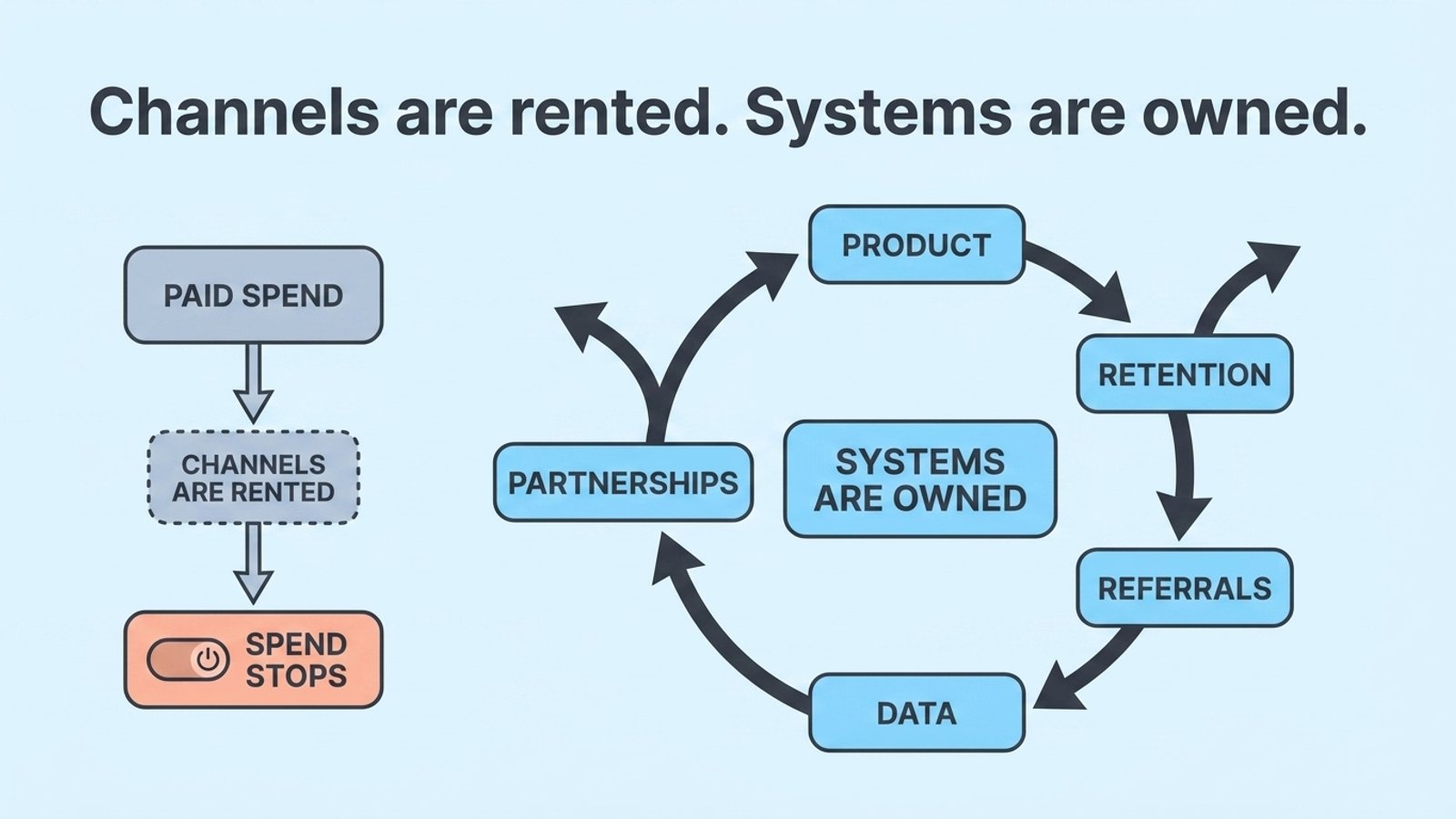
Channels are rented. Systems are owned.
If your growth strategy stops working the moment you stop spending, you do not have a growth engine. You have a customer acquisition expense.
That distinction matters because CAC rises, competitors copy what works, algorithms change, and teams burn out. A growth model built only on paid media or founder hustle usually becomes less efficient over time, not more efficient.
What makes a strategy innovative is simple:
- It compounds
- It reduces marginal acquisition cost
- It improves retention
- It creates defensibility
- It gets stronger with usage, trust, or data
How to Choose the Right Growth Strategy for Your Startup
Before you copy what worked for Dropbox, Slack, Airbnb, or Notion, you need to ask a more basic question: what problem are you trying to solve?
The way that I look at it, every startup should evaluate growth strategy through five filters:
- Stage fit: Are you validating demand, finding product-market fit, or scaling?
- Business model fit: Are you SaaS, marketplace, consumer, AI, or service-enabled?
- Constraint fit: Is your bottleneck acquisition, activation, retention, monetization, or expansion?
- Compounding potential: Will this strategy get better over time?
- Defensibility: Will this create an advantage that is hard to copy?
Here’s the simple version:
| Startup Stage | Primary Goal | Best Strategy Types |
|---|---|---|
| Idea / MVP | Validate demand | Founder-led sales, niche communities, concierge onboarding |
| Early traction | Improve activation | Product onboarding, lifecycle email, user interviews, referrals |
| Post-PMF | Scale efficiently | SEO, partnerships, content loops, PLG, paid experiments |
| Marketplace scaling | Build liquidity | Supply seeding, geographic density, trust systems, matching |
| Growth stage | Create defensibility | AI personalization, network effects, ecosystem expansion |
Build Growth Loops Instead of Linear Funnels
A growth loop is a system where one user action creates the input for the next cycle of growth. Unlike a funnel, it does not end at conversion.
That is the shift founders need to understand. Funnels are useful for measurement. Loops are useful for compounding.
A few common loop types:
- Referral loops: Users invite other users
- Content loops: Users create pages, templates, reviews, or assets that attract traffic
- Collaboration loops: Product usage naturally pulls teammates in
- Data loops: More usage improves recommendations, matching, or outcomes
- Marketplace loops: More supply attracts more demand, which attracts more supply
Dropbox is the classic referral loop example. Slack built collaboration loops because one user invited a team. Calendly turned scheduling into distribution because every meeting link exposed new people to the product.
If you want to build a loop, ask:
- What repeatable action creates value in the product?
- What output comes from that action?
- Can that output drive acquisition, activation, or retention?
- Where is the friction in the loop?
That’s how growth becomes embedded in the product instead of sitting outside it.
Use AI to Create a Smarter Growth Engine
AI is only a growth strategy when it improves a business constraint. Plain and simple.
If AI helps you lower CAC, improve onboarding, predict churn, personalize experiences, or reduce support costs, it’s strategic. If it just makes your team feel modern, it’s theater.
Some practical ways startups can use AI for growth:
- Predictive lead scoring
- Personalized outbound messaging
- Search intent clustering
- Ad creative testing
- Dynamic onboarding flows
- AI support assistants
- Churn prediction
- Product recommendations
- Marketplace matching
- Pricing optimization
For startups, this matters because AI can increase output without requiring proportional headcount. McKinsey, OpenAI, and the broader AI tooling ecosystem have made this clear: teams that operationalize AI around workflow bottlenecks move faster.
The mistake I see is using AI too generically. Don’t ask, “How do we use AI?” Ask, “Where are we leaking growth, and can AI improve that specific point?”
Design for Network Effects From the Beginning
Network effects happen when the product becomes more valuable as more people use it. This is one of the strongest forms of defensibility in startup growth.
Andrew Chen’s work in The Cold Start Problem made this idea mainstream for a reason. Once a network starts working, it can become very hard for competitors to displace.
Here are the main types:
| Type | How It Works | Example |
|---|---|---|
| Direct network effect | More users improve value for all users | |
| Two-sided network effect | More supply attracts demand and vice versa | Airbnb, Uber |
| Data network effect | More usage improves recommendations or matching | Spotify |
| Ecosystem network effect | More integrations increase utility | Shopify |
| Content network effect | More content attracts more users | YouTube, Reddit |
The rule here is not “go broad.” It’s the opposite. Start narrow, create density, and solve the cold start problem in one segment first.
For marketplaces especially, total signups are a vanity metric. Liquidity is the real metric. If users cannot reliably find the other side of the market and complete a successful transaction, growth is fake.
Adopt Product-Led Growth
Product-led growth means the product helps drive acquisition, activation, conversion, and expansion. Users experience value before a heavy sales process gets involved.
This works especially well when the “aha” moment is clear and can happen quickly.
Common PLG tactics include:
- Free trials
- Freemium plans
- Interactive demos
- Self-serve onboarding
- Templates
- Collaboration features
- Product-qualified lead triggers
- In-product upgrade prompts
Slack, Figma, and Notion all benefited from this model because usage itself created expansion. One person started, then a team joined, then the account grew.
The key decision rule is simple: if your product can deliver meaningful value before a sales conversation, PLG is worth testing. If it requires major setup, long implementation, or deep stakeholder buy-in upfront, it may need a sales-led layer first.
Build Community and Partnerships Into Distribution
Community-led growth works because trust scales before sales does. People buy faster when they feel educated, connected, and validated by peers.
Strategic partnerships work because the right partner already has access to the customer attention you want. Instead of building every audience from zero, you plug into existing trust.
I’ve seen founders waste effort across too many channels before they understood the customer and funnel. One founder runs paid ads, posts on LinkedIn, starts a blog, hires a freelancer, experiments with email, and still has no consistent pipeline. I think the lesson is obvious: startup marketing fails when founders treat channels as the strategy instead of starting with the customer, the message, and the funnel.
That same principle applies here. Community and partnerships only work when the positioning is clear. Before you scale distribution, you need to know exactly who you help, what outcome you create, and why that audience should care.
Turn Retention Into a Growth Strategy
A lot of founders obsess over top-of-funnel growth while leaking users after signup. That is one of the fastest ways to burn money.
Retention-led growth is one of the most underrated innovative business growth strategies because it improves everything else:
- Better retention improves LTV
- Better LTV makes paid acquisition more viable
- Better retention creates more referrals
- Better retention produces more usage data
- Better retention increases expansion revenue
If you improve onboarding, shorten time-to-value, personalize lifecycle messaging, and proactively address churn risk, you create compounding effects across the business.
My point is this: acquisition gets attention, but retention creates durability.
Use Founder-Led Thought Leadership to Build Trust
For many startups, especially B2B, AI, marketplace, and infrastructure businesses, the founder is part of the distribution engine.
Founder-led content builds trust at scale. It can drive branded search, partnerships, backlinks, investor interest, and high-intent inbound demand.
This does not mean posting generic motivational content. It means publishing sharp opinions, real lessons, customer insights, failed experiments, category analysis, and useful frameworks.
Reid Hoffman, Brian Balfour, Sean Ellis, and teams around a16z and GrowthHackers helped shape how modern founders think about distribution because they taught the market while building in public.
If your market needs education before conversion, founder-led thought leadership is not optional. It is leverage.
The Innovative Startup Growth Strategy Scorecard
The best growth strategy is not the trendiest one. It is the one that attacks your current bottleneck while building long-term advantage.
Score each strategy from 1 to 5 on these criteria:
| Criteria | Question |
|---|---|
| Speed to test | Can we validate this in 30 days? |
| Compounding potential | Will it get stronger over time? |
| CAC impact | Can it lower acquisition cost? |
| Retention impact | Will it improve stickiness? |
| Defensibility | Is it hard to copy? |
| Team capability | Can we execute it now? |
| Revenue impact | Can it move revenue meaningfully? |
Prioritize strategies with high compounding potential, clear measurement, and direct alignment to your current bottleneck.
A 90-Day Plan to Implement Innovative Growth Strategies for Startups
If you only do three things, do these.
Days 1–30: Diagnose
- Identify your biggest growth bottleneck
- Review acquisition, activation, retention, and revenue data
- Interview customers and lost prospects
- Map your current funnel and any existing loops
- Score 5 possible strategies
Days 31–60: Test
- Pick one primary strategy and one supporting strategy
- Launch 3 to 5 focused experiments
- Instrument the metrics
- Use AI where it can speed analysis or personalization
- Collect qualitative feedback alongside quantitative data
Days 61–90: Scale
- Double down on what worked
- Kill weak channels and weak experiments
- Document the playbook
- Assign ownership
- Tie the system back to revenue and retention
Common Mistakes Startups Make
These mistakes show up constantly:
- Chasing trends instead of bottlenecks
- Scaling acquisition before product-market fit
- Confusing traffic with traction
- Adding features instead of improving activation
- Ignoring retention
- Launching marketplaces too broadly
- Using AI without a data strategy
- Measuring vanity metrics instead of business outcomes
If you cannot connect a strategy to a measurable behavior change or business result, it is probably not a strategy yet. It is just an idea.
Frequently Asked Questions About Innovative Growth Strategies for Startups
What are the best innovative growth strategies for startups?
The best innovative growth strategies for startups include growth loops, AI-driven personalization, network effects, product-led growth, community-led growth, strategic partnerships, retention-led growth, and pricing innovation.
How do startups choose the right growth strategy?
Start with the bottleneck. Then evaluate stage, business model, team capability, and whether the strategy compounds over time.
What is the difference between a funnel and a growth loop?
A funnel is a linear path from awareness to conversion. A growth loop is a repeatable system where user actions help create future acquisition, retention, or product value.
How can AI help startup growth?
AI can help reduce CAC, improve lead quality, personalize onboarding, analyze churn risk, automate support, and improve product recommendations.
Why are network effects important?
Network effects make the product more valuable as more users join. That can improve retention, strengthen defensibility, and lower acquisition cost over time.
Final Thoughts: Build Growth That Compounds
The startups that win are rarely the ones trying every tactic. They are the ones that understand the customer, identify the bottleneck, and build systems that compound.
So yes, test paid acquisition if it makes sense. Use it. Learn from it. Scale it when the economics work. But do not confuse paid spend with a real engine.
The takeaway is simple: the most effective innovative growth strategies for startups create value that outlasts the campaign. They turn product usage into distribution, retention into expansion, data into personalization, and trust into durable demand.
If growth stops when spend stops, it isn’t a strategy. It’s a bill.
Frequently asked questions about innovative growth strategies for startups
What are the best innovative growth strategies for startups?
The best innovative growth strategies for startups include growth loops, AI-driven personalization, network effects, product-led growth, community-led growth, strategic partnerships, retention-led growth, and pricing innovation.
How do startups choose the right growth strategy?
Start with the bottleneck. Then evaluate stage, business model, team capability, and whether the strategy compounds over time.
What is the difference between a funnel and a growth loop?
A funnel is a linear path from awareness to conversion. A growth loop is a repeatable system where user actions help create future acquisition, retention, or product value.
How can AI help startup growth?
AI can reduce CAC, improve lead quality, personalize onboarding, analyze churn risk, automate support, and improve product recommendations.
Why are network effects important?
Network effects make the product more valuable as more users join. That can improve retention, strengthen defensibility, and lower acquisition cost over time.