

AI Does Not Automatically Create Network Effects in Tech Startups

Mitch Wilder
Entrepreneur & Systems Thinker
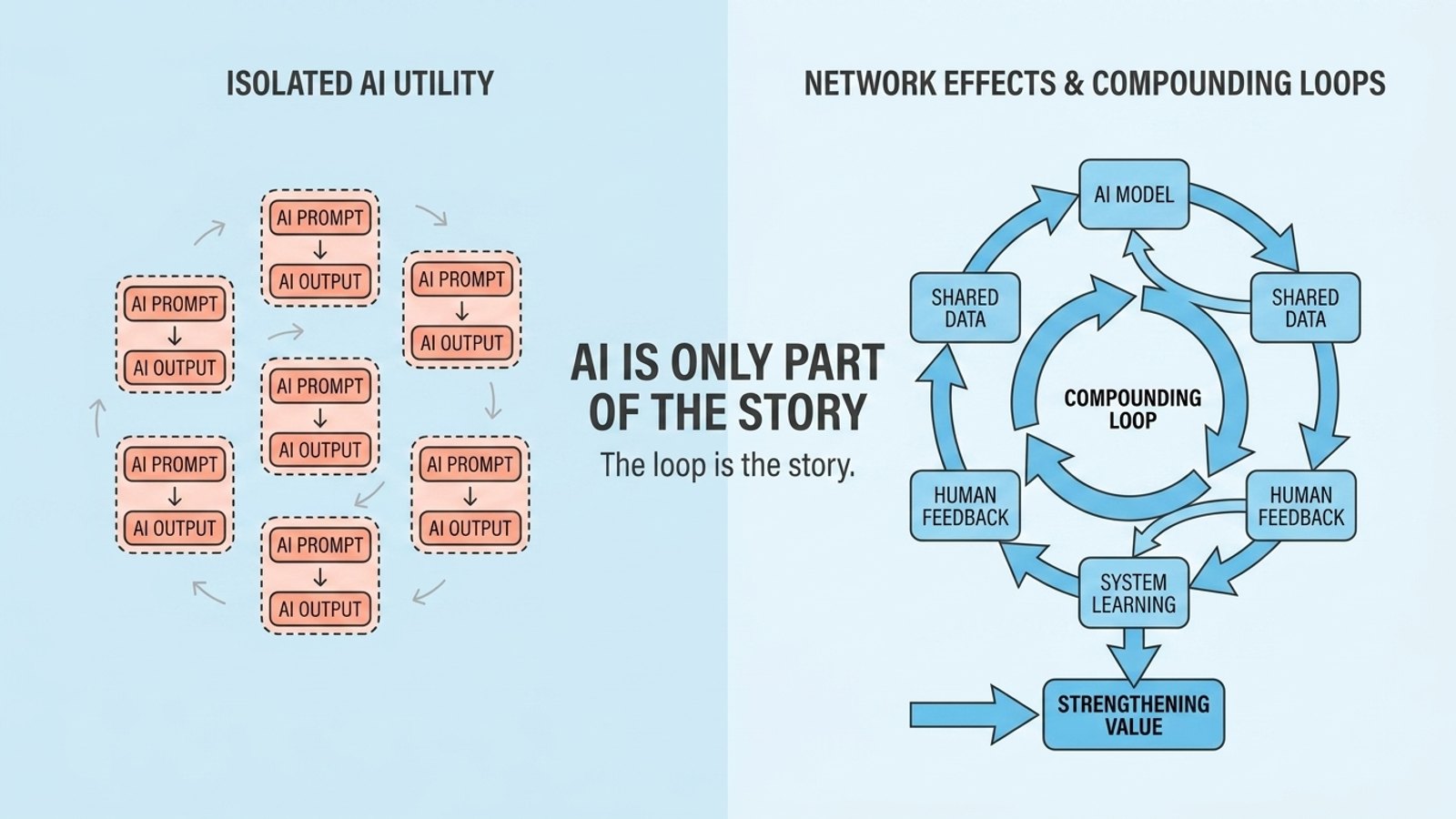
Most founders right now are treating AI like a moat by default. I think that’s a mistake. AI can absolutely strengthen a product, improve outcomes, and speed up growth, but AI does not automatically create network effects in tech startups.
That distinction matters more than people realize. If you confuse AI utility with network-driven defensibility, you can end up building a startup that looks impressive in a demo but scales like a commodity.
Quick answer
Network effects in tech startups happen when each new participant makes the product more valuable for other participants. AI is not a network effect by default — it is a capability layer. Real network effects require that user participation improves the experience for others in a compounding, hard-to-replicate way.
Key Takeaways
- Network effects in tech startups happen when each new participant makes the product more valuable for other participants.
- AI is not a network effect by default. In many cases, it is just a feature layer on top of shared models.
- A startup can have great AI output and still have zero defensibility if users are getting isolated experiences.
- Real network effects show up through users, suppliers, developers, content, workflows, or proprietary data improving value for others.
- The test is simple: does every new user improve the product for future users, or not?
- If your AI startup depends on the same models, similar interfaces, and non-proprietary inputs as everyone else, your moat is probably weak.
- The best AI companies build feedback loops, workflow lock-in, ecosystem participation, and data advantages.
- Founders should measure network strength through retention, density, contribution, and outcome improvement — not hype.
What Are Network Effects in Tech Startups?
Network effects in tech startups occur when a product becomes more valuable as more users, suppliers, developers, data, content, or participants join and interact. They matter because they can increase retention, improve acquisition efficiency, strengthen defensibility, and create compounding growth.
A product with 10,000 users is not automatically a network-effect business. If those users are isolated from each other and their activity does not improve the experience for anyone else, you have user growth, not a network effect.
Why Founders Keep Getting This Wrong
A lot of startups are using AI to create output faster. That’s useful. But usefulness and defensibility are not the same thing.
The way that I look at it, founders are blending together four separate ideas: AI capability, viral growth, automation, and network effects. Those are not interchangeable.
An AI app can be impressive and still be easy to replace. A product can go viral and still have no lasting moat. A company can automate work and still have linear growth economics. Plain and simple, network effects require one user’s participation to improve value for others.
Network Effects vs. AI Utility vs. Virality
| Concept | What it means | Key question |
|---|---|---|
| Network effects | More participants increase product value for others | Does each new participant improve the experience for other users? |
| AI utility | AI helps a user complete a task better or faster | Does the product solve a real problem better than alternatives? |
| Viral growth | Users bring in more users | Are users spreading the product? |
| Economies of scale | Growth improves cost structure | Does size improve margins? |
Why AI Does Not Automatically Create Network Effects
AI only creates network effects when usage improves the product for other users in a durable way. If every user is having a one-off interaction with a model, there may be value, but there is no network effect.
Here are the four scenarios most AI startups actually fall into:
Scenario 1: Pure AI utility (no network effect)
The product uses AI to complete a task better or faster for each individual user. Each user’s experience is independent. The product does not improve because more people use it. AI utility is real value, but it is not a moat by itself.
Scenario 2: Virality plus AI (no network effect)
Users share the product because it produces impressive output. Growth is fast but relies on acquisition rather than compounding value. The product does not get harder to replace as it grows.
Scenario 3: Data flywheel (potential network effect)
User activity generates proprietary data that improves the model or product for future users. This is the beginning of a real network effect, but only if the data is unique, compounding, and hard to replicate.
Scenario 4: Ecosystem network effect (strong moat)
Users, developers, or contributors build on the platform, which creates cross-side value. More participants on one side improve outcomes for participants on the other side. The product compounds structurally.
How to Build Real Network Effects in an AI Startup
Most network effects in AI startups come from one of these five sources:
1. Proprietary data loop
Usage creates interaction data — match outcomes, quality ratings, workflow completions, or feedback — that is fed back into the model to improve outcomes for future users. The data must be proprietary, not replicable with public data.
2. Collaboration and shared workflows
When more team members use a product together, the product becomes more useful because of shared context — templates, brand assets, knowledge bases, approval chains, or feedback loops. Figma is the textbook example: each new collaborator makes the shared file richer.
3. Ecosystem and developer participation
More developers building integrations, plugins, or templates creates more value for all users. The ecosystem becomes part of the product’s defensibility.
4. Reputation and trust signals
In marketplaces or community platforms, reviews, ratings, and trust histories built up over time create sticky advantages. The reputation data is proprietary and hard to replicate.
5. Habit and workflow lock-in
When a product becomes embedded in daily workflows, team rituals, or business-critical processes, switching costs rise. This is not a traditional network effect, but it compounds like one.
How to Measure Network Strength in an AI Startup
Stop measuring AI hype and start measuring network health. Use these metrics:
- Retention by cohort: does retention improve as the user base grows?
- Match quality: do outcomes improve over time per unit of input?
- Contribution rate: what share of users contribute data or content back to the platform?
- Density: is the network concentrated enough in a specific use case or geography to create liquidity?
- CAC trend: is customer acquisition getting more or less efficient over time?
- Competitor replicability: how long would it take a well-funded competitor to reach the same data or ecosystem advantage?
Free · About 10 minutes
Find the weak link in your network
Answer 25 focused questions to assess your network-effect proof, atomic network, liquidity and retention, growth loops, and defensibility.
Take the free assessment →Frequently Asked Questions About Network Effects in Tech Startups
What are network effects in tech startups?
Network effects in tech startups happen when a product becomes more valuable as more users, data, developers, suppliers, or participants join and interact. The key is that growth improves product value for others, not just company revenue.
Do AI startups automatically have network effects?
No. AI startups only have network effects if user activity improves the product for future users in a shared, compounding way. Using AI alone does not create a network effect.
What is the difference between AI utility and network effects?
AI utility means the product helps a user do something better or faster. Network effects mean each additional participant increases product value for other participants.
Can data create a network effect?
Yes, but only when the data improves the product in a way that compounds and is hard to replicate. Generic or non-proprietary data usually does not create a strong moat.
What is an example of an AI company with real network effects?
An AI product builds real network effects when user feedback, workflow data, or ecosystem contributions improve recommendations, automations, or outcomes for other users — and that data is proprietary to the platform. The key is shared improvement, not isolated usage.