

Network Effects in Marketplaces: Why Liquidity Is Where Theory Turns Into Economics

Mitch Wilder
Entrepreneur & Systems Thinker
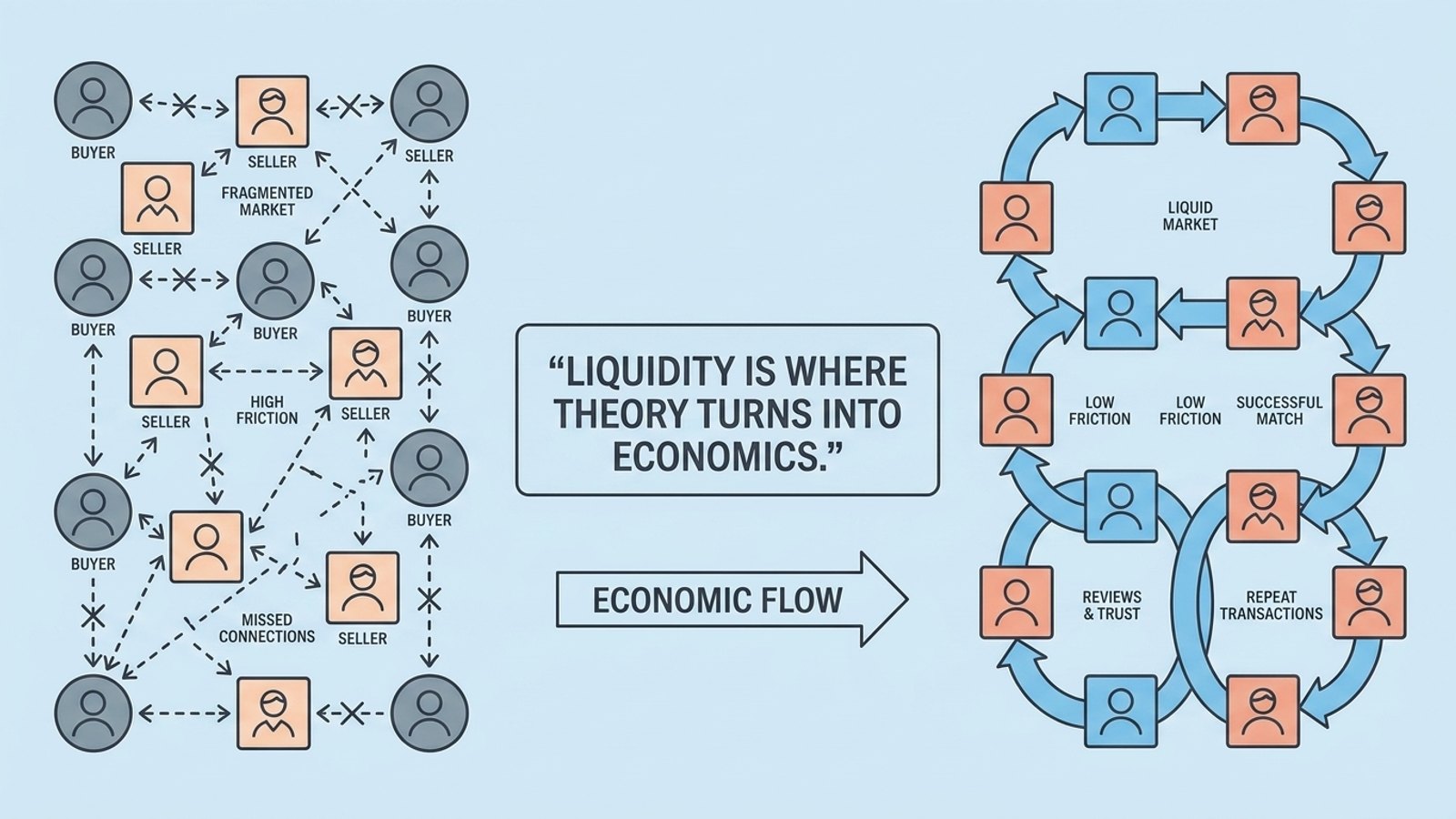
Most founders think they’re building network effects when they’re really just buying traffic. That’s the trap.
A marketplace does not become valuable because more people show up. It becomes valuable when more participation improves the odds of a successful transaction for everyone else. That is the shift from marketplace theory to marketplace economics — and liquidity is the point where that shift becomes real.
Quick answer
Network effects in marketplaces are not about user count. They are about outcome density — how liquidity, trust, and match quality compound into a platform that gets harder to leave and harder to replicate with every successful transaction.
Key Takeaways
- Network effects in marketplaces happen when each new participant makes the platform more valuable for other participants.
- In two-sided marketplace network effects, more supply can improve buyer outcomes and more demand can improve seller outcomes.
- More users do not automatically mean stronger marketplace network effects.
- Marketplace liquidity is one of the clearest signals that network effects are working.
- The strongest marketplaces improve trust, matching, retention, and data quality with every transaction.
- Local density usually matters more than broad reach in the early stages.
- Negative network effects are real and can make a marketplace worse as it grows.
- AI can strengthen marketplace network effects, but only when powered by proprietary marketplace data.
- A marketplace moat forms when liquidity, reputation, trust, and workflows become difficult to replicate.
What Are Network Effects in Marketplaces?
Network effects in marketplaces happen when each new buyer, seller, provider, listing, review, or transaction increases the value of the platform for other participants.
In a buyer-seller marketplace, that usually means more sellers create better selection for buyers, and more buyers create better revenue opportunities for sellers. When that loop improves matching, trust, and retention, the marketplace gets stronger over time.
My point is this: growth is not the same thing as a network effect. A bigger marketplace is only better if it creates better outcomes.
Why Network Effects Matter So Much in Marketplace Platforms
The way that I look at it, a marketplace is always trying to improve two value equations at once. For buyers, the goal is better selection, faster results, stronger trust, and less friction. For sellers or providers, the goal is more qualified demand, better conversion, and more reliable earnings.
When network effects are working, they can improve:
- Buyer conversion and repeat purchase rate
- Seller retention and earnings reliability
- Match quality and time-to-transaction
- Organic growth through referrals
- Data quality for AI-powered features
- Trust and safety for all participants
- Pricing power and marketplace take rate
- Long-term defensibility
The Three Types of Marketplace Network Effects
Direct (same-side) network effects
These happen when more participants on one side of the marketplace make it more valuable for others on the same side. LinkedIn is a strong example: more professionals on the platform makes each profile and connection more valuable.
Cross-side (indirect) network effects
These are the most common in two-sided marketplaces. More drivers improve rider outcomes on Uber. More hosts improve guest outcomes on Airbnb. The two sides reinforce each other.
According to research on platform economics, platform businesses that generate strong cross-side network effects can reach a tipping point where the network becomes self-sustaining, creating a “winner-take-all” dynamic in markets where multi-homing is difficult (Harvard Business Review).
Data network effects
These happen when more transactions generate proprietary data that improves matching, ranking, fraud detection, or personalization for future participants. This is where AI amplification becomes most powerful.
What Marketplace Liquidity Actually Means
Marketplace liquidity is the likelihood that buyers and sellers can successfully find each other and complete a transaction in an acceptable time.
High liquidity means: a buyer searches, finds relevant supply, trusts what they find, and completes a transaction. Low liquidity means: the buyer searches, sees thin or irrelevant supply, and leaves without transacting.
Plain and simple: if your marketplace has low liquidity, more traffic creates more frustrated users — not more growth. The cold start problem and liquidity problem are closely related. For early-stage playbooks, see cold start problem solutions.
How Real Marketplace Examples Show Network Effects
Airbnb
More verified hosts improved trust and selection. More verified guests improved host conversion. More completed bookings generated more reviews. More reviews improved match quality and reduced booking friction. The trust data — built over years of real transactions — is the moat, not the listing interface.
Uber
More drivers in a city reduced wait times. Lower wait times improved rider satisfaction and frequency. More riders increased driver earnings. Better driver earnings attracted more drivers. Each completed ride improved dynamic pricing data — a compounding data network effect.
Etsy
More unique sellers created better selection for buyers seeking handmade and vintage items. More engaged buyers improved seller conversion and motivated more sellers to invest in quality listings. The buyer-seller relationship ecosystem — built on trust, craftsmanship, and community — created switching costs for both sides.
Upwork
More skilled freelancers improved hiring outcomes for clients. More satisfied clients attracted more work to the platform, improving earnings opportunities for freelancers. Work history and verified reputation signals — proprietary to the Upwork platform — created strong stickiness on both sides.
Negative Network Effects: When More Users Hurt
Not all growth makes a marketplace better. Negative network effects happen when more users reduce platform value. Signs include:
- Overcrowded supply with low conversion for sellers
- Buyer overwhelm from too many irrelevant options
- Declining match quality from poor-quality listings
- Fraud, spam, or bad actors degrading trust
- Price erosion from supply-side saturation
- Slow response times when demand spikes without supply scaling
Managing negative network effects requires active curation, quality gates, and trust infrastructure — not just more growth.
How AI Strengthens Marketplace Network Effects
AI can amplify marketplace network effects in four specific ways:
- Match quality: better recommendations improve transaction success rates, which improves retention and referrals
- Trust and fraud detection: AI can identify suspicious behavior and protect the reputation economy faster than manual review
- Pricing optimization: dynamic pricing that improves seller revenue and buyer conversion strengthens both sides of the flywheel
- Personalization: buyers who see more relevant supply convert better, which signals to sellers that the platform delivers qualified demand
The key condition: AI only amplifies marketplace network effects when it is trained on proprietary transaction, behavioral, and trust data from within the marketplace. Generic AI features without proprietary data do not build a moat.
Metrics That Reveal Marketplace Network Effects
Buyer-side metrics
- Search-to-transaction conversion rate
- Time-to-first-successful-transaction
- Buyer repeat purchase rate
- NPS and satisfaction scores
Seller-side metrics
- Seller retention rate at 30, 60, 90 days
- Earnings reliability and consistency
- Listing quality improvement over time
- Organic seller referrals
Marketplace-level metrics
- Liquidity rate (successful transactions per search or listing)
- Match quality improvement over time
- Organic growth as a share of total acquisition
- CAC trend per cohort
Frequently Asked Questions About Network Effects in Marketplaces
What are network effects in marketplaces?
Network effects in marketplaces happen when each new participant increases value for other participants. In a two-sided marketplace, more sellers can improve selection for buyers, and more buyers can improve monetization for sellers.
What is marketplace liquidity?
Marketplace liquidity is the likelihood that buyers and sellers can successfully find each other and complete a transaction in an acceptable amount of time. High liquidity means users can quickly get the outcome they came for.
What are cross-side network effects?
Cross-side network effects happen when growth on one side of the marketplace increases value for the other side. More drivers helping riders or more hosts helping guests are common examples.
Can a marketplace grow without real network effects?
Yes, but it will usually be less defensible. Without network effects, growth depends more on paid acquisition, sales effort, or brand than on compounding value — which means margins erode as the business scales.
What are negative network effects?
Negative network effects happen when more users reduce marketplace value — overcrowded supply, low-quality listings, buyer overwhelm, fraud, or shrinking seller earnings. Active quality management is required to prevent them.